Thursday, November 30, 2006

DFAT had way too many senior moments on AWB...

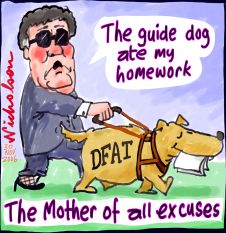
One of the DFAT staff called before the Cole Commission has blown a big whistle on the "spin" put on her evidence by the report. The Age reports Genevieve Hamilton, who was First Secretary at Australia's diplomatic mission to the United Nations from 1995 to 1998, said the Cole report avoided the question of who in the Government was responsible for failing to stop AWB from rorting UN sanctions. "I think that the commissioner's report has given ministers and departments the armory that they needed to say that they were not at fault."

Ms Hamilton said her evidence was misrepresented to draw a conclusion that she disagrees with — that DFAT had no responsibility for checking contracts and detecting kickbacks.

The former diplomat complained about the misuse of her evidence after seeing a draft of the report, but her concerns were not redressed."

The Age article goes on to say that "During the inquiry, AWB managers claimed their dealings in Iraq had been approved by the Australian Government because all contracts were checked by DFAT officials. But several DFAT employees told the inquiry they never examined the contracts for probity, instead describing their role as that of a "post-box".

Part-responsibility for vetting the contracts lay with DFAT's employee at the UN mission, Bronte Moules. Ms Hamilton was asked to give evidence to the inquiry because she was Ms Moules' predecessor, working in New York until 1998 — the year before the kickbacks started.

Mr Cole's report adopts the DFAT argument that Ms Moules and others fulfilled a "postbox" function and says that Ms Hamilton's evidence was "to the same effect". But Ms Hamilton said the postbox excuse was a "total cop-out". She added: "I would never have thought like that."

She said that references in the contracts to "transport fees" paid by AWB, later revealed to be kickbacks, should have raised a red flag for DFAT staff and concerns should have been taken up at the highest levels.

Ms Hamilton told The Age that while in the job, she considered it her duty to scrutinise contracts she passed to the UN. She is confident she would have noticed the kickbacks had they occurred while she was in charge. "I would have raised hell about it," she said."

From my experience, I can confirm that senior officials would not ignore such red flags unless it was made abundently clear from on high that they should do so. It has to be remembered that DFAT had an oversight responsibility in an area of UN dealings that was super-sensitive. It is inconceivable that responsible officers would ignore warnings of this nature.

The difficulties of doing business in what have come to be known as "spoilt markets" (where competitors routinely offer mixed credits, concessional financing and kickbacks to do business) is not grounds for turning a blind eye to this type of corruption, particularly as Australia had committed defence and other assets to uphold the sanctions regime against Iraq. This goes beyond the normal argy bargy of trading in developing countries into an area that undermines our national security interests and our integrity as a trustworthy member of the international community.

In any other Westminister-style jurisdiction the responsible Minister would have resigned by now. I think the whole government should take responsibility for this scandal but I retain an idealistic notion that elected leaders are trustees of the community - when that trust is misused they forfeit the right to lead.
Wednesday, November 29, 2006

Why Iraq & AWB?

Some readers may be wondering why this blog has apparently gone off on a tangent. I am focussed on the Iraq war and the AWB scandal because these events typify an egregious disregard for human rights, good governance and government accountability.

This mindset led Australia to deviate from good international citizenship toward a monocultural fortress mentality fueled by fear, rampant individualism and intolerance of the different.

Our government is comfortable with bullying smaller countries that don't conform to our cultural projections and insecure posturing. Violations of refugee conventions, rule of law principles and other international machinery designed to protect human rights have become common currency and many of our citizens angrily declare our right to do so.

It is this latter phenomenon that I find most alarming. Some of the violent language and abuse being hurled around virtual spaces is frightful and reflects a fertile ground for the type of dog whistle politics on race, religion, ethnicity and so called "Australian-ness" that Howard taps into.

The 'us' and 'them' construct has worked well for Howard.

The Iraq war imbroglio and the AWB cover-up are indicators of the government's performance in the area of human rights, governance and accountability - I keep harping on these failings as I think it is important that Australians who believe Howard is acting in our best interests understand why so many of their fellow citizens are genuinely fearful of the direction this country is taking.

If this is the new Australian value system - Huston, we have a problem!

The big picture....

AWB daze...


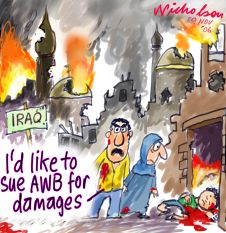
Nicholson in The Australian

Tuesday, November 28, 2006

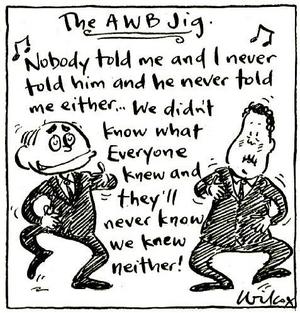
what we don't know can't hurt us, or, "do the AWB jig with me....."


Matt Price of The Australian has put the Cole Commission findings to punters on his blog. Matty thinks the fallout will be minimal (his ruminations are invariably soaked in the spirit of Aussie apathy, which may mean he is an accurate weather vane!). By contrast, I live in hope!

Click here to read Cole's report for yourself.

The responses to Price's blog piece suggest the apoplectic, self-righteous calls by Howard, Downer et al for apologies from Labor have gone down like a lead balloon. They will not escape opprobrium over this scandal, and neither should they. Following is a few offerings from the punters:

"Was it Harry S.Truman that said: “The buck stops here”? Well, I think that the current leaders of our country should be totally ashamed of the gross bumbling, incompetent manner in which they are supposed to run their various departments. For Mr Cole to absolve all the various department heads and other minors from any “knowledge” beggars belief, and for ministers to blandly state that they were “unaware” of any wrongdoings is akin to the ostrich sticking its head in the sand… or should that be wheat? Let me bring out that slogan from the early 1970s: “It’s time”."

"Gross incompetence; “no one told me” excuse yet again! Downer, Vaile and their senior staff should be sacked; but, as always, Howard will be too weak to do anything."


"Has Cole now validated the contemporary political version of “need to know”? In our bastardisation of the Westminster system, mandarins now exist to ensure ministers only hear good news—or bad news that plays well with the electorate.
One assumes the sub-mandarins have adopted the same ethos, and by the next decade the only reliable source of information will be the filing clerk."

"I think, Jill Courtney, the only DFAT public servant to openly admit that Alia was a name she knew, summed it up when she stated that under the Howard Government “any dissent was not tolerated”. However, under the previous Labor government, public servants were “basically encouraged to disagree and to speak their mind”. Says volumes on how this government has politicised the public service and therefore is never held accountable. Ministerial responsibility—a cornerstone of our democracy—does not exist under the Howard Government, which is to our detriment."

"How do the government ministers involved have the gall to draw their pay?

"The Government has a habit of denying any wrongdoing. That is what you get when the front bench is loaded to the hilt with lawyers.
No responsibility - “It was the fault of a staffer”.
No accountability “How much can I get away with?”

Which all leads to a Government permanently in denial and never admitting to any error nor offering any apology for any wrongdoing no matter how bleedin’ obvious. "


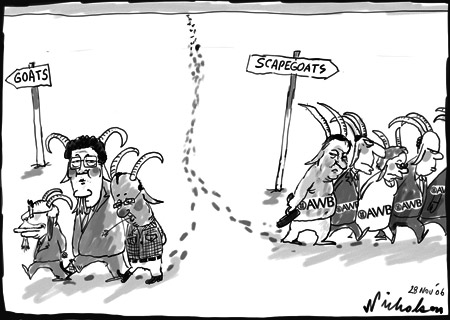
Nicholson in The Australian

Monday, November 27, 2006

Death penalty politics...

Christian Catalano underlines the inconsistency in the Howard Government's approach to the death penalty, and how damaging this can be in seeking leniency for Australians at risk in other jurisdictions.

This government has an ambivalent attitude toward lobbying governments on the death penalty. It seems to depend on whether proactive lobbying will suit the particular political spin being run on issues around the courts' decisions. If public sentiment is running against the convicted, such as in the case of terrorists and tyrants, the Howard govt is gung ho about the death penalty. If there is unease at home they go through a hand wringing exercise that smacks of hypocrisy. Some governments (Vietnam for example) have responded to Australia's representations and granted clemency, but the current politicised approach amounts to a horrible lottery.

Melbourne University professor of Asian law Tim Lindsey said the Government had "lost its leverage" on the issue.

"You can't have it both ways — if you support the death penalty for terrorists then you can't complain when it's applied to other offenders," he said.

Grain daze: Saddam allegedly embezzled billions by evading UN sanctions - who turned a blind eye then?


Reporting on Howard's evidence to the Cole Commission in April, Peter Hartcher had this to sat about our government:

"Howard's appearance yesterday seemed to confirm that the Government makes some of its most serious foreign policy decisions based on hunches and politics rather than objective analysis, and that Australia's national budget for intelligence, with disclosed spending of $1.1 billion a year, and all the expertise and information that it buys, is wasted on this Government.

How so?

The counsel assisting Cole, John Agius, SC, with the Prime Minister in the witness box, started probing Howard's knowledge of the rorting of the oil-for-food program that the UN had set up.

Agius reminded the Prime Minister of a speech he gave to the National Press Club in building support for the invasion of Iraq. Agius read out to Howard an extract of that speech, from March 13, 2003, in which Howard attacked Saddam Hussein:

"He has cruelly and cynically manipulated the United Nations oil-for-food program. He's rorted it to buy weapons to support his designs at the expense of the wellbeing of his people."

John Agius put it to Howard: "Clearly that statement, and a statement of such gravity, must have been based upon briefings that you received?"

Well, not really, said Howard. It was based mainly on open sources available to anyone who could read a newspaper or type "Google" - a speech by Britain's Foreign Secretary, Jack Straw, a press briefing by the US State Department and other miscellaneous reports.

Howard said he had asked one of his staff, the speechwriter, to check that reports or cables from Australia's diplomatic posts "supported the open-source claims and was satisfied that they did".

So Howard had not needed the intelligence system to tell him that Saddam was cheating the sanctions system. For how long before his press club speech had Howard known this, Agius wanted to know.

"It would be well before that. It's very hard - probably a year or more that I would have had that belief, but, like a lot of these things, it would have been a mixture of bits and pieces plus a predisposition to believe the worst, I suppose, of that regime."

Agius: "Well, in that connection, did you ever have any suspicion that any Australian company, including AWB, one of the largest exporters to Iraq, might have been involved in that rorting?"

Howard: "No, I didn't."

Golly gosh....

News Alert & Alarmed: PM demands good governance from Pacific states, confirms AWB just misunderstood by his Ministers!